
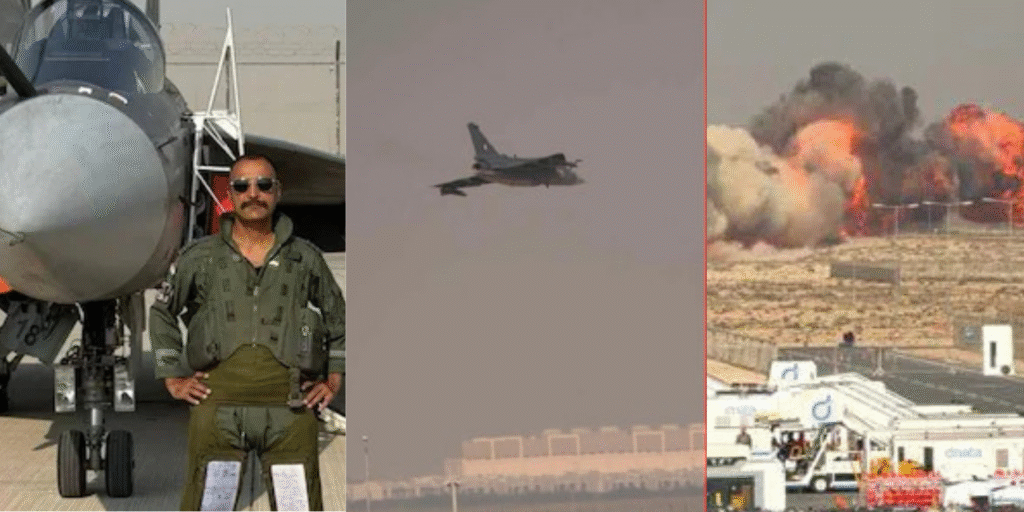
A Hero’s Final Flight: Understanding the Dubai Tejas Crash and Honouring Wing Commander Namansh Syal, the Brave Pilot Who Gave His All for the Nation
Get Our Defence Expert Guidance Fill Form: Call Back
On 21 November 2025, the global aviation community witnessed a heartbreaking tragedy when an Indian Air Force HAL Tejas Mk-1 fighter jet crashed during a demonstration at the Dubai Air Show. What was meant to be a moment of pride—India showcasing its indigenous Light Combat Aircraft on an international platform—turned into a scene of shock and sorrow. The crash claimed the life of Wing Commander Namansh Syal, a skilled pilot, instructor, and patriot whose service embodied dignity and devotion.
The Crash: What Happened in Dubai
During a routine aerobatic display at Al Maktoum International Airport, the Tejas was seen executing a tight negative-G turn — a manoeuvre demanding extreme precision. At an altitude reportedly under 500 feet, the aircraft lost lift and entered an irrecoverable nose-dive. Within seconds, it slammed into the ground and burst into a massive fireball, sending thick black smoke billowing into the skies.
Witnesses were stunned. Aviation experts immediately recognised the danger of performing such a manoeuvre at low altitude, leaving very little margin for technical error or recovery. The Indian Air Force quickly confirmed the loss of the pilot, and international messages of condolence began pouring in.
A Court of Inquiry has now been set up to determine the exact cause of the crash. While social media speculated about technical issues, the IAF clarified that what some mistook for an oil leak earlier was merely condensed water drainage, a normal occurrence for aircraft in humid conditions.
But beyond the technical analysis lies a deeper human story — the story of the man in the cockpit.
Behind the Uniform: Who Was Wing Commander Namansh Syal?
Wing Commander Namansh Syal came from Patialakad village in Himachal Pradesh’s Kangra district — a place known for its lush hills, and now, for giving India one of its finest aviators. Born to Jagan Nath Syal, a retired Army Medical Corps officer, and Bina Devi, he grew up in an environment that valued service, sacrifice, and discipline.
He studied at Sainik School Sujanpur Tira, where his leadership qualities blossomed early. Described by teachers as “brilliant and grounded”, he soon set his sights on serving the nation. His dream led him to the National Defence Academy, where he joined the Hunter Squadron. At the NDA, he was known for his calm temperament—a trait that later made him a dependable fighter pilot.
Commissioned into the IAF in December 2009, he went on to fly some of India’s most challenging fighter platforms, including the MiG-21, the Su-30 MKI, and later the indigenous Tejas. His colleagues described him as “fearless but measured, daring but disciplined”—the perfect combination for a frontline combat pilot.
He served not only as a fighter pilot but also as a flying instructor, training young pilots and shaping the future of the IAF. This role reflected his unmatched skill and his commitment to giving back to the service that shaped him.
Behind all the medals and missions, he was also a family man — a husband and father. His wife, serving in the IAF herself, stood proudly by his side throughout his journey. They have a young daughter, whose world was built around her father’s warmth and presence.
A Tribute to a Nation’s Hero
Some heroes don’t need monuments — their deeds carve their legacy into the hearts of the people. Wing Commander Syal was one such hero.
He soared above boundaries, both in spirit and skill. He represented India in multiple airshows, performing daring aerobatics with grace and precision. Each manoeuvre he executed wasn’t merely a display of flying; it was a salute to his nation — a statement that India’s skies are guarded by its bravest.
His life embodied discipline, courage, and unwavering duty. His death reminds us of the silent risks fighter pilots take every single day. They fly machines that push the limits of physics, operate under tremendous pressure, and put their lives on the line so the nation sleeps peacefully.
In losing him, India hasn’t just lost a pilot—it has lost a mentor, a son of the soil, a protector, and a national asset.
The Tejas Program: A Moment of Reflection
The HAL Tejas is India’s pride — a symbol of indigenous innovation. This crash, however, brings forth a necessary moment of reflection:
Safety protocols at airshows may need revisiting.
Technology upgrades, such as enhanced ground collision avoidance systems, can help prevent future tragedies.
Training patterns for aerobatic routines might need further enhancement to factor in aircraft performance limits and environmental conditions.
Every accident is a lesson — and every lesson must be used to prevent the next.
Though Wing Commander Syal’s final flight came too soon, his legacy will continue to inspire thousands of cadets, aviators, and dreamers. His students will carry his teachings. His missions will echo his courage. His life will remind every Indian that behind each uniform is a human being whose heart beats for the tricolour.
Heroes never truly die. They live on in memories, in the skies they once flew, and in the nation they served.
Wing Commander Namansh Syal — the nation salutes you.
Your final flight may have ended, but your spirit will forever soar.